Food
How much protein per meal, with Indian food
Get your daily total right first, about 1.6 g per kilogram of body weight if you lift. Then spread it over three or four meals of roughly 25 to 40 g, built from dal, dairy, eggs, meat and soya.
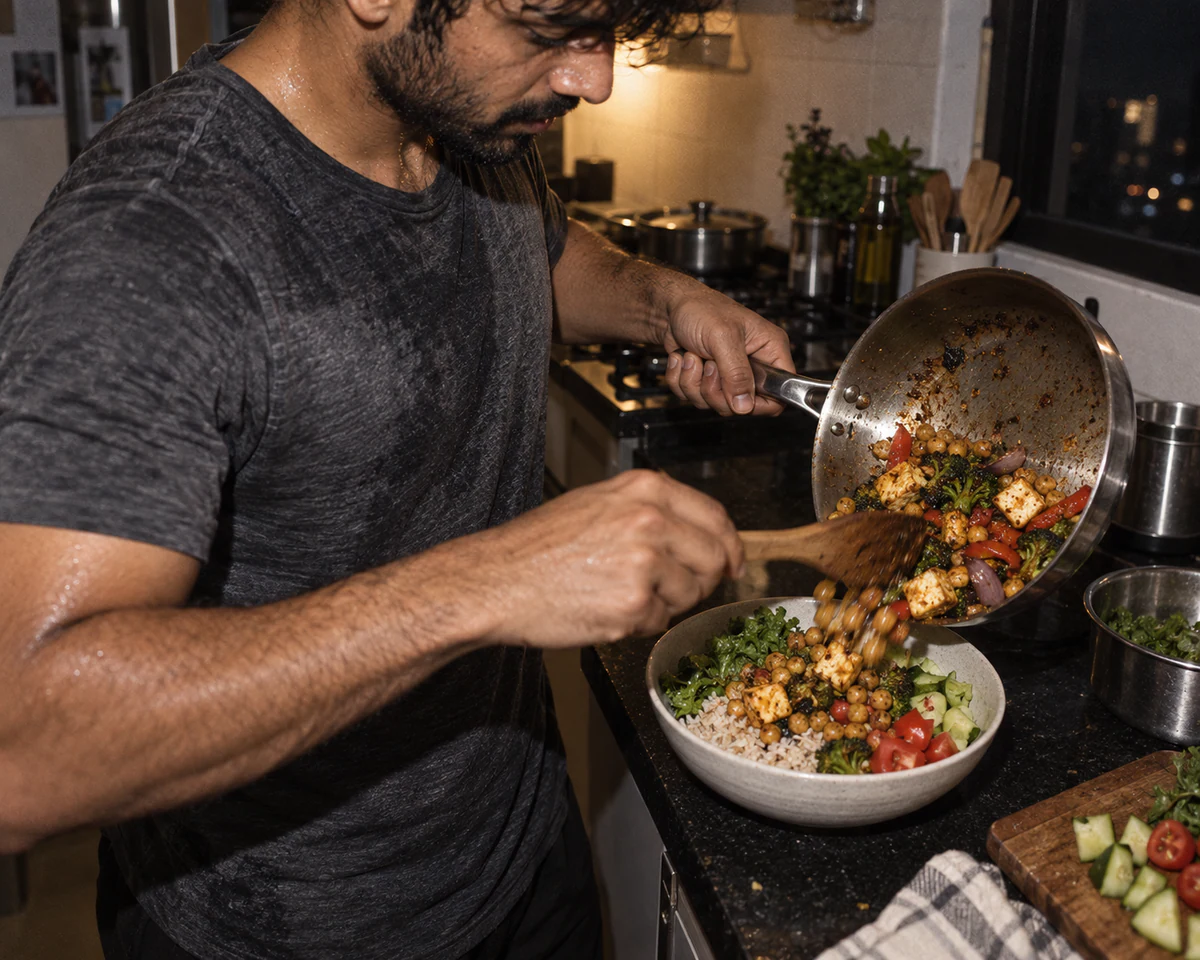
Your daily total matters more than any single meal. If you lift, aim for about 1.6 g of protein per kilogram of body weight each day, which is 112 g for a 70 kg person. Spread that over three or four meals and each one lands between 25 and 40 g. Your body does not throw away everything above 30 g in a sitting, so a bigger dinner is fine when breakfast was light.
Where the 30 g ceiling came from
Early lab studies gave young men a fast-digesting protein, usually whey, after a workout and measured how fast their muscles built new protein. That rate stopped rising at around 20 to 25 g, and the extra was thought to be broken down for energy [2]. From there it was a short step to "the body can only use 30 g at a time".
Two things undercut it. Those studies used a single fast protein on its own, and most people eat protein in a meal with carbohydrate, fat and fibre, which slows digestion [2]. And a 2023 study found that 100 g of protein after exercise produced a larger response than 25 g, lasting more than 12 hours, with little of the extra protein burned for energy [3].
That result has limits too. The participants were recreationally active young men who did not lift regularly, and a commentary on the study points out that early evidence does not show the same result in resistance-trained women [4]. So a large meal is not wasted, and there is still a reason to spread protein out.
Daily total first
A meta-analysis of 49 trials found that extra protein increased gains in strength and lean mass during lifting programmes, and that the benefit levelled off at a total intake of about 1.62 g per kilogram per day [1]. The effect was larger in people who already trained. Some people aim a little higher to leave a margin.
| Body weight | About 1.6 g per kg per day |
|---|---|
| 55 kg | 88 g |
| 70 kg | 112 g |
| 85 kg | 136 g |
Then spread it out
In one study, trained men drank 80 g of whey over 12 hours after lifting, in one of three patterns: eight doses of 10 g, four of 20 g, or two of 40 g [5]. Four doses of 20 g produced the highest rate of muscle protein building. A 2021 review found that people who ate protein more evenly through the day tended to have more muscle, though the link with strength was unclear [6].
A workable rule is about 0.4 g per kilogram at each of three or four meals [2]. For a 70 kg person that is about 28 g a meal, and more at one meal is fine.
What 25 to 40 g looks like
Figures below come from the Indian Food Composition Tables and the Indian Nutrient Databank [7] [8], with curd and soya chunks from USDA data [9]. Cooked dal varies the most, because it depends on how much water goes in. The figure here is for a thin home dal, at about 2.5 g of protein per 100 g.
| Food | Amount | Protein |
|---|---|---|
| Paneer | 100 g | 19 g |
| Chicken breast, raw | 100 g | 22 g |
| Chicken curry | 250 g bowl | 29 g |
| Boiled eggs | 2 eggs, 100 g | 13 g |
| Soya chunks, dry | 40 g | 21 g |
| Rajma curry | 250 g bowl | 15 g |
| Mixed dal, cooked | 300 g bowl | 7.5 g |
| Curd | 150 g bowl | 5 g |
| Cow's milk | 250 ml glass | 8 g |
| Roti | 1 medium, 45 g | 2.6 g |
| Boiled rice | 200 g | 5 g |
- Dal, roti and curd: a bowl of dal, three roti and a bowl of curd come to about 21 g. Add 80 g of paneer to the sabzi and it reaches about 36 g.
- Rajma chawal: a large bowl of rajma, a plate of rice and a bowl of curd come to about 25 g.
- Eggs and milk: two boiled eggs and a glass of milk come to about 22 g.
- Chicken curry and roti: a bowl of chicken curry and two roti come to about 35 g.
- Soya pulao: 40 g of dry soya chunks cooked into a plate of rice comes to about 26 g.
Dal on its own rarely reaches 25 g at a normal serving. It does most of its work alongside dairy, eggs, meat, soya or a second pulse.
A day for two body sizes
A 60 kg vegetarian, about 96 g over four meals: eggs and milk at breakfast, or paneer bhurji with two roti (about 20 g); dal, roti, curd and paneer at lunch (about 36 g); a glass of milk in the evening (8 g); soya pulao at dinner (about 26 g). That comes to about 90 g, so a second bowl of curd somewhere closes the gap.
An 80 kg person who eats meat, about 128 g over four meals: eggs and milk (about 22 g); chicken curry with roti at lunch (about 35 g); a bowl of curd with fruit in the afternoon (5 g); rajma chawal with curd at dinner (about 25 g); 100 g of paneer or chicken breast added somewhere in the day (19 to 22 g). That lands around 106 to 109 g, about 20 g short.
Whether you need a supplement
Most of the trials in the meta-analysis above used protein supplements, and they helped because they raised total intake [1]. If your meals already reach your daily total, a shake adds nothing measurable. If they fall short by 20 to 30 g most days, as the 80 kg day above does, one scoop of whey or a plant protein closes the gap. So does a larger portion of chicken or paneer.
Logging it in Agyl
Agyl's food search holds over 1,500 Indian dishes and ingredients, including cooked dals, rajma curry, paneer and roti, with figures from the same Indian tables used here. You can log by grams or by the portion you ate, save a recipe you cook often, add a packaged food from its label, and re-add anything from a "Logged often" list. Today adds up the day's protein with calories, carbohydrate and fat.
Sources
- 1.Morton RW, Murphy KT, McKellar SR, et al. A systematic review, meta-analysis and meta-regression of the effect of protein supplementation on resistance training-induced gains in muscle mass and strength in healthy adults. British Journal of Sports Medicine, 2018. 49 studies, 1,863 participants.
- 2.Schoenfeld BJ, Aragon AA. How much protein can the body use in a single meal for muscle-building? Journal of the International Society of Sports Nutrition, 2018.
- 3.Trommelen J, van Lieshout GAA, Nyakayiru J, et al. The anabolic response to protein ingestion during recovery from exercise has no upper limit in magnitude and duration in vivo in humans. Cell Reports Medicine, 2023.
- 4.Witard OC, Mettler S. The anabolic response to protein ingestion during recovery from exercise has no upper limit in magnitude and duration in vivo in humans. A commentary. International Journal of Sport Nutrition and Exercise Metabolism, 2024.
- 5.Areta JL, Burke LM, Ross ML, et al. Timing and distribution of protein ingestion during prolonged recovery from resistance exercise alters myofibrillar protein synthesis. Journal of Physiology, 2013.
- 6.Jespersen SE, Agergaard J. Evenness of dietary protein distribution is associated with higher muscle mass but not muscle strength or protein turnover in healthy adults. A systematic review. European Journal of Nutrition, 2021.
- 7.Longvah T, Ananthan R, Bhaskarachary K, Venkaiah K. Indian Food Composition Tables 2017. National Institute of Nutrition (ICMR). Paneer, milk, eggs, chicken breast, dals and pulses.
- 8.Indian Nutrient Databank (INDB). Anuvaad Solutions and partners, derived from IFCT 2017. Cooked dal, rajma curry, chicken curry, roti and boiled rice.
- 9.USDA FoodData Central. Yogurt, plain, whole milk (171284) and soy flour, defatted (174275). Curd and dry soya chunks, which IFCT 2017 does not list.